16.09.11
While looking for a book to read, I found one of my old History textbooks. Having read the section on the great depression of the 1930s, I thought I'd share it. Hopefully the original publisher's and author's drive to educate will outweigh any temptation to enforce copyright, should they stumble upon this page.
It's interesting to compare the current economic slump to what was written about the 1930s'. There are a number of common elements, but many of the locations, players and types of debt and speculation have changed somewhat.
Extract from
Mastering Modern World History, Second Edition, by Norman Lowe, published by Macmillan - pages 111 to 113. The numbering and use of bold and italic type are from the original text.
(a) What caused the great depression?
(i) American industrialists, encouraged by high profits and aided by increased mechanisation, were producing
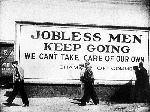
too many goods for the home market to absorb. (in the same way as American farmers). This was not apparent in the early 1920s, but as the 1930s approached unsold stocks of goods began to build up, and manufacturers produced less; since fewer workers were required, men were laid off; and as there was no unemployment benefit, these men and their families bought less. And so the vicious circle continued.
(ii) There was a
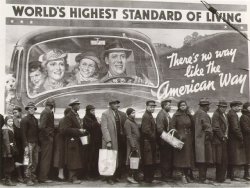
maldistribution of income, which means that the enormous profits made by industrialists were not being shared evenly among the workers. The average wage for industrial workers rose by about 8 per cent between 1923 and 1929 but during the same period industrial profits increased by 72 per cent. An 8 per cent increase in wages meant that there was not enough buying power in the hands of the general public to sustain the boom: they could manage to absorb production for a time with the help of credit but by 1929 they were fast approaching the limit. Unfortunately manufacturers, usually in the form of the super-corporation, were not prepared to reduce prices or to increase wages substantially, and so the
glut of consumer goods built up. This refusal by the manufacturers to compromise was shortsighted to say the least; at the beginning of 1929 there were still millions of Americans who had no radio, no electric washer and no car because they could not afford them. If employers had been content with rather less profit there is no reason why the boom could not have continued for several more years while its benefits were more widely shared. Even so, a slump was still not inevitable provided the Americans could export their surplus products.
Read full article + Share / Comments (Permalink)
07.09.11
It's a long-standing argument, and no doubt there's a lot of truth in it. Local businesses seem to manage to stick around, but it must be difficult to compete with the power and resources of the supermarket giants.
Supermarkets succeed for various reasons, but the most important one is that most people prefer to shop in a supermarket rather than trail round the local shops. I like the idea of supporting local business, but supermarkets are more convenient, usually have a better range and thanks to their massive buying power, they're often cheaper.
The solution seems obvious - become a supermarket.
No one market trader or local shop owner could do it alone, of course, but if they got together and pooled their resources perhaps they could rent or buy a town centre location or a big plot of land out of town and make their own supermarket.
So why isn't it happening all the time?
I really don't know. I can think of various reasons, but I'm not sure any of them are correct. It actually does happen to some extent (most of the major retailers started out as market traders or small businesses), but not as much as I might expect. Near me, there's a nice little indoor market. If all of those people got together, they'd have the basis of a proper mass retail business. I suppose an indoor market is already almost a supermarket, but it would be better if it worked more like a proper supermarket, with shopping trolleys and a place to pay at the end, after the shopper had gathered everything they wanted.
That indoor market space could act as the start of a business conveyor belt: The existing businesses move up to being a proper supermarket, and the space gets filled with a new generation of market traders, who eventually save up enough money to go on to make the next supermarket.
Read full article + Share / Comments (Permalink)
16.05.11
People often think that the most powerful people in the country are politicians.
They make the laws that rule us all. Despite their power, they are elected by us, the people and we can throw them out of office every five years. There are more than 60 million of us in this country. If most of us want something, a politician hoping to be elected will probably promise it. If the government oversteps the line, there are potentially 60 million people to scare the living bejeezus out of them by violently smashing through their police lines and then queuing politely for their turn to sit around peacefully in Fortnum and Masons.
So, perhaps it is us, the people, who are most powerful. But how would people have protested against the Iraq War if they didn't know it was happening? In the most part, we got that information from the news industry. If they hadn't reported it, or if they'd reported only the pro-war arguments and none of the anti-war arguments, then how many would have turned up to that protest?
This is the bluntest of tools the news industry has at its disposal. They have other, more subtly sharp ones, all the more effective for being less noticeable.
It would have been difficult for the media to suppress the flaws in the stated arguments for the Iraq war, because they were quite obvious and so a lot of people would have noticed them and passed them on by word of mouth or the internet.
But not all flaws in arguments are so obvious, and some things do go unreported.
Recently, the press ran several days of coverage on the
issues surrounding
equality - equal pay, equal opportunities,
and so on. Between their news pieces, editorials and comments they covered almost every aspect of the issues.
Except, in all the excitement, they somehow neglected to mention that the government was running a public consultation on exceptions to the age discrimination laws (or if they did, it wasn't very prominent - I didn't see it and I was actively looking for it). This
consultation was published on the government's
Central Office of Information website, which I'm guessing journalists must check regularly for government press releases. Or perhaps they rely on press releases via email, I don't know. There are now less than 10 days left on this consultation.
Read full article + Share / Comments (Permalink)
13.05.11
Perhaps in this internet age it would be more accurate to say, "those who fail to learn from history are doomed to misquote people and then attribute the quote to the wrong source".
Try a Google search for the bits of the quote you feel sure about and see what I mean.
Having spent a few years carefully reading and sifting the news available online, I have come to the conclusion that critical thinking is a vital skill that everyone needs. I sometimes see comments on news websites calling for it to be taught in schools. It's a long time since I was in school, so I don't know what's being taught these days, but I
was taught critical thinking skills at school - in history lessons, for example.
All the required elements were there - think about the source of the information, and what ulterior motives they might have. Look at the way information is presented - what's being pushed to the front as important, and what is being omitted? Did the source have access to all the facts? What was the social background to the source?
In maths we were taught to examine statistics and recognise the tricks used to misrepresent data. In history, we even studied Goebbels - repeat a lie often enough and it becomes the truth. In English we saw how language can be used to persuade and beguile, though at the time I didn't even begin to suspect just how deep that particular rabbit hole went.
In general, my learning experience was a good one: I was lucky to have good teachers and the teaching methods employed in the late eighties and early nineties seemed to really suit my particular psychology. I found most lessons quite interesting, which always helps. But my point here is about what wasn't taught, and what went unsaid. All those valuable critical thinking skills I learned turned out to be useless to me, for the simple fact that no-one ever taught me (as far as I remember) that they needed to be applied to everything, all the time. Not just against history.
Read full article + Share / Comments (Permalink)
18.04.11
Poor Nick Clegg.
Before the election he was perhaps the most popular man in politics - even other politicians were clambering over each other to agree with him. Or so the press would have us believe, anyway. Actually, while some newspapers were singing his praises, others were mocking him. Arguably the latter sections of the press were those that might be seen as part of the establishment, and their mockery acted as reverse-psychology support for his anti-establishment positioning. I may be over-thinking that, but probably not.
I'd guess Clegg's support came from two main groups. Firstly, political tacticians who probably wanted to see Labour removed from power, but didn't trust the Conservatives to rule by themselves and thus wanted a coalition government. The second group of supporters were probably a little less politically astute and supported him because of the policies he said he wanted to bring in.
Many of Clegg's policies were extremely populist, but perhaps rather unrealistic. The biggest clue was probably his opposition to Trident. On the face of it, it might sound like a brilliant idea - the US are our allies and they have plenty of nukes, let them take up any slack while we save money. Or, you could take the compelling view that nuclear weapons are just downright evil and wrong, and we should set a good example to the world by reducing our ability to project death across the globe in the hope that others will see the light and be nice to us.
It would be nice if the latter argument was true. If the world's dictators were sane, kind and reasonable, and democratic states were made up of voters who were well-informed and logical, then it might just work. The evidence of history and current affairs suggests this is not the case. Even if I'm wrong about this, there are probably deep-rooted political reasons why it doesn't matter one way or the other.
Read full article + Share / Comments (Permalink)
12.04.11
In the recent budget, the government once again put up prices on tobacco and alcohol - just like every government always does. Rolling tobacco in particular took a heavy hit, going up about 50p on a 25g bag, or £1 on a 50g bag.
The details weren't announced in the budget speech, but were buried in the budget document. The alcohol increases weren't really mentioned either, they were also hidden away. Those changes don't take effect until October, and came about as a result of changes made in 2008.
The government is also steering towards forcing cigarette manufacturers to put their products in plain packaging, suggesting that this will somehow reduce the appeal of perhaps the most addictive substance in the world.
In my experience cigarette manufacturers, like many other companies, follow predictable patterns with their products. Every now and then, a new product will arrive which is packaged similarly to some other similar product, but is cheaper. The similar branding gives a clue to the customer that the new, cheaper brand X is similar to Brand Y, allowing customers to switch. Once hooked, the company slowly increases the price over the years that follow. Eventually the profit margin becomes so great that there is room in the market for a similarly-branded but cheaper competitor to steal their customers away, and the cycle begins again.
Quite often, the 'competition' is actually between different products made by the same company, as the tobacco industry is heavily monopolised - most products are made by either Imperial Tobacco or British American Tobacco, in much the same way that a lot of household cleaning products are made by either Unilever or Reckitt. Despite this, there is some competition.
Plain packaging may reduce this competition, by making it difficult for competing products to advertise themselves as being similar to a more expensive alternative. Customers may find themselves locked in to a particular brand, at which point the manufacturer may feel free to crank up their profit margins safe in the knowledge that their customers won't know where else to turn to get a better deal.
Read full article + Share / Comments (Permalink)
08.04.11
Robert Peston muses on the latest developments in the Murdoch phone hacking scandal.
The interesting thing about this scandal is that it very much looks like a case of the stupid being caught and the more deviously clever getting away, as is so often the case.
From what I've read, it appears that (most of?) the phone 'hacks' have consisted of celebs having their mobile phone voice mail accessed by the press because they didn't bother to change the default PIN on their voice mail service.
Mobile phone providers generally provide a service whereby if you ring a mobile number and get put through to voice mail (for example by not answering the phone), then you can not only leave a message but also listen to recorded messages if you know the PIN. Not changing the default PIN is rather like leaving your front door unlocked. Yes, the mobile phone companies should do more to make customers change the default number. Yes, it's unethical and perhaps downright criminal for anyone to take advantage of someone who doesn't know what they're doing. Yes, it's foolish to not read the manual and secure your voice mail.
My reason for highlighting the stupidity of the celebs for not changing their PINs is not to ridicule them (who hasn't made a mistake of this sort, at some point?) but to point out that the simplicity of this so-called-hack means it is easy to do, and also easy to track down and catch. The unsaid reverse of this, is that there are probably much more sophisticated hacks currently undetected and unreported.
On a 'social engineering' level, it would be somewhat surprising if there wasn't some bribery or blackmail going on within the low-paid workers of major communications companies, such as Virgin or BT. As communication hubs for telephone and internet, they'd be obvious and valuable targets, and the people who work there who have access to the recordings, logs and traffic probably aren't paid enough for all of them to resist bribery, nor sufficiently vetted to resist blackmail. If that sounds far-fetched, then perhaps you didn't read the news stories quite recently about phone banking call centre staff giving up information about their clients for money in their lunch breaks, as reported in the press. I'll add a link if I can find it again.
Read full article + Share / Comments (Permalink)
10.03.11
Lord Hutton of Furness' report on recommendations for the future of public sector pensions was published today.
The full text of the Hutton Report, running to 215 pages, can be found here.
As was widely predicted, Lord Hutton has recommended a
Career Average Revalued Earnings (CARE) scheme to replace the current final salary schemes.
Both
The Guardian and
The Independent report that public sector unions are threatening large scale strike action over the pensions reforms.
Lord Hutton's main recommendations are as follows (taken directly from the report):
Recommendation 1: The Government should make clear its assessment of the role of public
service pension schemes. Based on its framework of principles, the Commission believes
that the primary purpose is to ensure adequate levels of retirement income for public service
pensioners.
Recommendation 2: Pensions will continue to be an important element of remuneration. The
Commission recommends that public service employers take greater account of public service
pensions when constructing remuneration packages and designing workforce strategies. The
Government should make clear in its remits for pay review bodies that they should consider how
public service pensions affect total reward when making pay recommendations.
Recommendation 3: The Government should ensure that public service schemes, along with
a full state pension, deliver at least adequate levels of income (as defined by the Turner
Commission benchmark replacement rates) for scheme members who work full careers in
public service. Employers should seek to maximise participation in the schemes where this is
appropriate. Adequate incomes and good participation rates are particularly important below
median income levels.
Recommendation 4: The Government must honour in full the pension promises that
have been accrued by scheme members: their accrued rights. In doing so, the Commission
recommends maintaining the final salary link for past service for current members.
Recommendation 5: As soon as practical, members of the current defined benefit public
service pension schemes should be moved to the new schemes for future service, but the
Government should continue to provide a form of defined benefit pension as the core design.
Read full article + Share / Comments (Permalink)
26.02.11
Council recruitment is at an all time low right now, but these tips apply to a wide range of public sector organisations and other areas that tend to be influenced by the public sector's methods, such as universities and charities. Just bear in mind that the latter examples are free to be a bit more individual in the way they work.
Of course, all the usual advice for job hunting applies, there's plenty of good tips on recruitment websites and similar: Do some research on the place you're applying to. Do try to guess what questions will be asked and plan some answers. Don't put your feet on the table during the interview. Do write your application form in blue or black ink. Don't use crayon or your own blood. That sort of thing.
Public sector recruitment follows rules and a formula that is supposed to make recruitment fair and open to anyone who has the skills to do the job, no matter where those skills were learned. For example, if you've done something as a hobby or as part of school work then in theory that's just as good as skills picked up in a proper job.
Thanks to this system, if you have the right skills and you follow the formula on the application process, you should be almost guaranteed to get an interview.
The Application Form
Forget CVs. The public sector never accepts CVs, they judge everything on how you fill in the application form. If you send a CV, they will ignore it. Most of the application form will be quite easy to understand - just follow the instructions. Most of it is simple personal details and the previous work history and education history sections are basically just in a familiar CV format anyway. The part where you really need to pay attention is the big blank boxes they leave for 'Any other information', or 'Information in support of your application', or similar. Sometimes these sections are split between a few different sections, such as 'Outside interests and hobbies relevant to the application' and 'Relevant work experience'.
Read full article + Share / Comments (Permalink)
09.02.11
The government has
published a code of recommended practice for local authorities on data transparency, and has opened a consultation on the proposed measures. The consultation is open to anyone and ends on 14th March. Responses can be given by email, post or online on their forums. See the above link for details.
The government has already asked that councils provide details of all spending over £500, and many councils have already complied -
you can see the results here.
There are still a number of
councils dragging their feet, such as Nottingham City Council. This new code of practice strengthens the government's position in requiring the data from local authorities, as it is being issued as an official code of practice under Part 2 of the Local Government, Land and Planning Act.
The proposed data requirements are as follows:
- All expenditure over £500, with grants and payments under contract to the voluntary and social enterprise sector clearly itemised and listed.
- All senior council staff are to have their salaries published, along with job descriptions, responsibilities, budgets and numbers of staff. Senior staff are defined as anyone earning more than £58,200, which is the starting wage for a senior civil servant [Note: a 'senior' council worker wage is usually much lower than this, at around £40,000.] Staff can opt-out of having their names published.
- An organisational chart of the staff structure of the local authority.
- Councillor allowances and expenses.
- Copies of contracts and tenders to businesses and to the voluntary community and social enterprise sector.
- Policies, performance, audits and key indicators on the authorities fiscal and financial position.
- Data of democratic running of the local authority including the constitution, election results, committee minutes, decision-making process and records of decisions.
The proposed code of practice also states that local authorities should create an inventory of all the data they hold, and sets out a number of basic (but useful) technical requirements, such as requiring that the data be published in CSV format (Comma Separated Variable - a data format readable by a very wide range of applications, including the ever-popular MS Excel).
Read full article + Share / Comments (Permalink)
29.01.11
Tony Blair's been in the news a lot recently thanks to his second appearance at the Chilcot Inquiry into the handling of the Iraq War.
There's been various news stories suggesting (again) that Blair had made up his mind to go to war long before the government 'officially' decided to go to war. He also stands accused (again) of running an almost presidential style of government, and not properly consulting his cabinet.
I've recently been reading
The Blair Years - Extracts from The Alastair Campbell Diaries, published in 2007.
What does Mr Blair's long-time spin doctor and loyal supporter have to say about it all?
Strangely, his book pretty much confirms it all, though admittedly it's somewhat open to interpretation - he certainly never explicitly says Blair made up his mind about Iraq beforehand (it would be strange if he did, all things considered), though he's fairly clear that Blair called the shots and cabinet consultation was very limited.
On the latter point, Campbell tends to look at everything through a prism of what is "professional", and presents a very black-and-white view of either working for the good of the party, staying "on-message" and toeing the line, or working against it. Cabinet members who spoke out, or spoke their mind, are regularly described in very derogatory terms, and Blair is said to have spoken in much the same way. Many of the female cabinet members in particular are derided for their lack of what Blair and Campbell see as 'professionalism', and even the popular Redcar MP Mo Mowlam is blasted, and her importance in the Northern Ireland negotiations is talked down compared to her own, more detailed description of events in her book,
Momentum.
Campbell's description of the final cabinet meeting to discuss Iraq essentially describes the cabinet being railroaded into agreeing what had already been decided.
Read full article + Share / Comments (Permalink)
19.01.11
The coalition government published its Localism Bill on 13th December 2010. This legislation weighs in at 184 pages for the Bill and 247 pages for its schedules and is designed to implement many of the government's policies that have already been set out, including laying the legal foundations of the Government's "Big Society" vision. It's wide-ranging, covering all sorts of issues of interest to local government.
The Bill received its second reading on 17 January 2011, and will go on through three more stages in the House of Commons and five stages in the House of Lords (possibly being changed as it goes) before becoming law. An explanation of the process can be found
here. The full text of the Bill can be found
here.
The BBC news website has a shorter summary of the Bill
here. This summary doesn't include all the measures covered by the BBC, but it concentrates in greater depth on measures of particular interest to local government and public power and democracy.
Community Right to Challenge - Public Sector Competition
[Part 4, Chapter 3 of the Bill]. Any voluntary or community group, charity, parish council or two or more council employees are entitled to put forward an "expression of interest" to a council, indicating that they would like to run one of the council's services, or help to run a service.
The council must consider the expression of interest, with particular consideration of the possible social, economic or environmental benefits of accepting the proposal.
If the proposal is accepted, the council must then begin a procurement exercise for that service.
Additional Freedoms for Councils
Councils are to be given a "general power of competence". [Part1, Chapter 1 of the Bill]. They are to be allowed to anything they are not expressly forbidden from doing. This enables a council to do pretty much anything a person can do. In particular, councils can run a business or provide a chargeable service of any kind anywhere in the UK or abroad, for any reason. The income from a service is not allowed to exceed the costs of running the service. This does not alter the rules under part 6 of the Local Government Act 1972, part 1A of the Local Government Act 2000 or any arrangements that "authorise a person to exercise a function of a local authority."
Read full article + Share / Comments (Permalink)
11.01.11
Nottinghamshire-based activist group 'Notts SOS' are holding a public meeting on Saturday 15th January 2011 to share ideas and discuss strategies for resisting local cutbacks.
Formed in September 2010, the group aims to "oppose cuts to services, job losses and cuts in benefits" and "support workers' organisations, service users [and] community groups in fighting cuts in Nottingham City and Nottinghamshire."
The group has so far managed to organise protests and attract
national media coverage.
Further details of the meeting can be found at the
Notts SOS website.
Comments / Share / Permalink15.11.10
The coalition government seems to be very fond of the phrase,
"we're all in it together", often pairing it with the Conservatives' Big Society policies. David Cameron has been using it as far back as 2005, in a
speech to the Policy Exchange think-tank.
The phrase jumped out at me when I first heard them using it, not because it's the title of a recent High School Musical song, but because it appears so often in the Terry Gilliam film,
Brazil. I was pretty sure it had an older, more directly political origin, though, so I did a little research - more on that later.
If you haven't seen
Brazil (and it's a great film in my opinion), here's a brief description. The film is set in a nightmarish future (or alternative reality - the technology is futuristic, yet retro - a sort of steam-punk meets 1940's film noir) in which life is controlled by an over-bearingly bureaucratic government, though it also seems to be a police state (suspected terrorists are tortured) with shades of rampant capitalism (torture victims must finance their own interrogation and extended interrogation risks the prisoner's credit rating).
The protagonist, Sam Lowry, has a lowly office job working for the Ministry of Information. He finds himself increasingly on the wrong end of the government's bureaucracy after he tries to correct the outcome of a computer glitch that causes an innocent man, Buttle, to be arrested on charges of terrorism. The actual 'terrorist', Tuttle, (played by Robert de Niro) is classed as a 'terrorist' thanks to being a maverick plumber, who circumvents Central Services' paperwork and drops out of the night sky to fix broken boilers and ducts without proper authorisation.
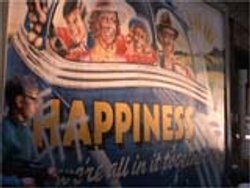
Propaganda posters are frequently seen in the background of the film, and on at least two occasions the slogan "we're all it together" can be seen (see still from the movie, above). The phrase is given a different slant later, when Tuttle refuses payment for his repair work - "we're all in it together, kid". It's given yet another angle later when he deals with two Central Services plumbers who are wrecking Sam's apartment, but I won't say more than that in case I spoil the pun for those who haven't seen the film.
Read full article + Share / Comments (Permalink)
15.11.10
The website is now three years old. To mark the occasion, I have finished working the
Intense Debate software into my Content Management System and public comments are now enabled across the site.
Fair Pay launched in November 2007 as the official website of the Fair Pay Action Group. It was a response to the pay cuts brought in by a Labour Council in the name of the Single Status Agreement. The Single Status Agreement was finalised by the unions in 1997 and was designed to implement the 1970 Equal Pay Act in 2007, and also work as a defensive measure against expensive tribunals brought against councils in the name of the Act. This site, and the group's members, worked to oppose the cuts, publicise the workers' plight and lobby councillors and politicians.
Today Fair Pay is fully independent and no longer associated to a particular council, nor is it part of the Fair Pay Action Group.
You can read more about Fair Pay's history
here.
Comments / Share / Permalink11.10.10
Opened on the 1st October, the "Review of Remuneration and Conditions for Officers and Staff" closes on 29th October, so if you if you want to make any comments on the matter, head on over to the
consultation website.
The site invites comments on 7 questions centred around Police pay and performance.
The review is headed by Tom Winsor, a lawyer and former rail regulator employed during the period of dismantling Railtrack and the creation of Network Rail. He is advised by Sir Edward Crew and Richard Disney.
Sir Edward Crew worked as Chief Constable of West Midlands Police between 1993 and 1996 and Chief Constable of Northamtonshire Police between 1993 and 1996. Richard Disney is the Professor of Labour Economics at Nottingham University and a research fellow for the Institute of Fiscal Studies.
The review covers both Police and civilian staff and will report on short term "improvements to the service" in February 2011 and again in June 2011 "on matters of longer-term reform". The review also must take into account the government's policy on pay and pensions, which will be informed by the findings of the two Hutton reports mentioned in earlier postings.
18.02.11 Edit: Tom Winsor's name was originally misspelled as "Tom Windsor", now corrected.
Comments / Share / Permalink11.10.10
Mr Marr's quote, above, is referring to bloggers. Presumably he's not counting his esteemed colleagues
Robert Peston,
Stephanie Flanders,
Gavin Hewitt,
Rory Cellan-Jones,
etc. amongst their numbers.
Speaking at the Cheltenham Literature Festival, he went on to say, "a lot of bloggers seem to be socially inadequate, pimpled, single, slightly seedy, bald, cauliflower-nosed, young men sitting in their mother's basements and ranting. They are very angry people."
I suspect this may often be true. I myself am single, balding, live with my parents and at times I'm somewhat annoyed about the chain of events that led to this situation, (
partially described here and
here).
I feel Mr Marr's comment underlines the problems with mainstream journalism on the internet today. It more-or-less accurately describes the immediate truth of the matter*, but it fails to address or explain the underlying causes or events that led to the situation. There's no attempt at analysis, or to inform and explain to the reader the more important underlying truth behind the present situation. Instead, Mr Marr's comments are reminiscent of the style of certain "Comment Is Free" journalists, in that he has chosen to say something that, while arguably true, is a generalisation specifically designed to grab attention and encourage comment and controversy, rather than to deliver something that truly educates and informs the readership with informed analysis, commentary and debate - the latter being the hallmarks and noble goals of true journalists, in my humble opinion.
It is no exaggeration to say that if it wasn't for the woefully poor national coverage of the effects of the Single Status Agreement on local government throughout 2007 to the present day, then this blog would not exist. The inadequate online coverage the issue has received from mainstream journalism makes me almost angry, though of course I'm not going to rant about it.
Read full article + Share / Comments (Permalink)
07.10.10
The Hutton report on public sector pensions
published its first report today [PDF, 176 pages]. The final report is due in time for Budget 2011. The BBC has produced some comprehensive coverage
here.
The report recommends that workers' level of contributions to their pensions is increased (except for the armed forces). It also suggests that schemes move away from a final salary (defined benefit) scheme. In their
press release reaction to the report, Unison opposed this recommendation. Hutton's report stops short of recommending a clear replacement to final salary and talks of various options to be looked at and possible hybrid schemes, though the career average scheme seems to be favourite.
It's interesting that the report devotes quite a few pages (see section 6.20) to discussing the difficulties associated with transferring pensions from the public sector to the private sector, as would happen in an outsourcing scenario, for example. The report notes that evidence from the private and even voluntary sector suggests that current TUPE (Transfer of Undertakings/Protection of Employment) and 'Fair Deal' regulations hamper the flow of workers from the public to private sector because of the extra risks and costs involved to the private sector.
Lord Hutton seems at pains to dispel the idea that public sector workers receive a 'gold-plated pension', an image emphasised in the media in recent months. He quotes the average public sector pension as being 'modest' at around £7,800, though I suspect this is the average pension across all workers, rather than, say, the average pension of a life-long, full-time worker, which is perhaps the more illuminating measure.
Lord Hutton does not recommend moving public sector schemes in line with the local government pension and turning them into self-funding models, nor does he advocate the reverse.
Read full article + Share / Comments (Permalink)
01.10.10
One of the most popular suggestions made to the Government's
Spending Challenge website is for the public sector to start using more
Open Source software.
This would mean replacing things like Microsoft Word with something like
OpenOffice Writer.
For almost every piece of software in common use in the public sector, there is a free alternative. Imagine how much money could be saved by replacing paid-for software with free Open Source alternatives. For every PC in the public sector, about £200 could be saved by replacing Windows with Linux and Office with OpenOffice. Considering how many public sector workers have a PC, and that there are 6 million workers in the public sector, there's some serious savings to be made.
Free, Open Source software is widely used - last time I checked the figures, it was estimated that around half the world's websites run on OSS - including this one. If I used paid-for commercial alternatives, I would be bankrupt by now.
So I guess you'd expect me to be an enthusiastic supporter of Open Source software in the public sector, right? Yes - but with a few small reservations.
First, the 'yes' part of the equation.
I have little doubt that widespread use of Open Source software would bring some massive savings. Additionally, Open Source software often performs better than commercial offerings, and as a result it will usually run much faster on the same, or older hardware. This means that IT departments could keep the same old computers for much longer, reducing upgrade costs for years to come. Local authorities regularly throw away machines far more powerful than the Linux machine I use as a development PC, file server, database server, and all-round workhorse. (It's an 800Mhz Pentium / 384Mb RAM, for the interested).
Read full article + Share / Comments (Permalink)
28.09.10
University fees and loans have been in the news recently. For what it's worth, I've decided to make my own small contribution to the debate, from a personal angle. Maybe it will help someone.
It's over ten years since I went to university, so some things have probably changed since then. I'm pretty sure it's not getting any cheaper, though.
To get into a particular university course, you need good grades in relevant A-level subjects. In other words I needed to know what my future career was going to be before the age of 14, when I choose what A-levels I took. While I'd learned many interesting things by the age of 14, I don't think I'd learned what I needed to know in order to make that decision. I knew almost nothing about politics and economics. But fear not, because at the time, teachers, careers advisers and parents all seemed to agree that while it was certainly preferable to strike out in a definite career direction, it didn't matter too much - a degree would open doors to a bright future, regardless of the subject.
By the end of my 3 years at university (and it was a generally useful experience and a lot of fun, I should point out), I had over £3,000 of student loan debt. But it wasn't really those loans that did the damage. The real damage was the culture of borrowing it created - of making it normal to accept loans to survive through a 'temporary' period of time, at the end of which it was expected that my shiny new degree would buy me a well-paying job and I would have no problems paying back the debt. Actually, 16 years later, I have never once earned a high enough wage to trigger the 'average wage' test that requires me to start paying back the loan.
Read full article + Share / Comments (Permalink)
21.09.10
According to a detailed article on the BBC News site, more than 9,000 public sector workers earn more than the Prime Minister (£142,500). Monday's BBC Panorama programme focused entirely on this report.
Perhaps less well-noticed is a similar but smaller report
recently published by the GMB union (thanks to one of the Fair Pay mailing list members for drawing my attention to it). The union report is focused only on council chief executives, rather than the public sector as a whole. Both lists agree that the Chief Exec of Wandsworth London Borough Council is the highest paid local authority worker, but they disagree on how much he's paid. The BBC say it's £299,925, while the GMB claim a figure of £356,891. Other salaries have similar discrepancies.
The BBC has been fairly clear with its methodology while the GMB's is slightly less clear, but it
appears that the BBC is quoting the salary that the individual
receives, while the GMB is quoting the figure that the taxpayer
pays. In other words, the GMB figures include the 'on-costs' - the money paid by the employer for National Insurance etc. If this is the case, then the BBC's figures more accurately describe what these people are being paid, whilst the GMB's figures more accurately describe how much these workers are costing the country.
Nottingham City Council stands alone in the GMB data in that it couldn't supply its chief exec's salary figures in time for the GMB report, but the BBC's figures appear to include Nottingham's Jane Todd - among various other anonymous highly-paid NCC staff. Assuming Ms Todd is the highest-paid member of the council, then her salary is £214,999. If her salary is scaled down like all the others in the BBC data compared to the GMB data, then the 'real cost' is probably much higher. If it were adjusted to be comparable to the increases shown in the GMB data then she would probably be one of the top-ten highest paid Chief Execs in the country.
Read full article + Share / Comments (Permalink)
29.06.10
The Government has announced that Will Hutton has been appointed head of a
review of pay in the public sector.
Will Hutton is an Observer columnist and former editor. He is also an executive vice chair of the
The Work Foundation.
The review will look into public sector pay, and will "make recommendations on how to ensure that no public sector manager can earn more than twenty times the lowest paid person in the organisation" - a Conservative manifesto pledge. Despite this, Government appears to have hinted recently that there may be some flexibility in this rule.
The review will produce a report in September, and a final report before the 2011 budget. Its scope includes all aspects of public sector pay, providing it does not encroach on the John Hutton Commission on public sector pensions.
Comments / Share / Permalink29.06.10
In an attempt to tackle a reported deficit of £2Bn, the BBC has
announced "the first major changes by a publicly-funded organisation" to their pension scheme.
The BBC say their proposals include closing the final-salary scheme to new members and restricting pension payouts to 1% per year. They also include an option whereby existing members of the scheme can continue with the revised final salary plan, or switch to a defined contribution scheme.
The proposals are subject to a consultation period, concluding in the autumn.
Comments / Share / Permalink29.06.10
John Hutton, former Secretary of State for Defence under Labour, is to head a commission to examine and make recommendations on public sector pensions. The commission will produce an interim report in the autumn, and a final report before the 2011 budget.
In 2008 the council workers' scheme, the Local Government Pension Scheme, underwent an
overhaul. It changed the scheme from being a 1/80th contribution to a 1/60th. Those earning more than £18,000 also had to increase their level of contribution. The LGPS is also distinguished by being one of the few schemes that maintains its own funds and pays its retired workers from that fund - most other public sector schemes do not maintain their own fund, and instead retired workers are paid from government funds. Of course, regardless of who holds the funds, all workers with a pension make a contribution, though the percentage contributed by both the employer and employee varies across schemes.
In the last budget, George Osborne announced that all public sector pension payout were to be indexed to the Consumer Price Index measure of inflation. The CPI is based on a 'basket of goods' measure, and does not include house prices.
Reports in the media suggest that workers may face a choice between increased contributions (effectively a pay cut), or reduced payouts.
The list of pensions schemes to be examined by the commission is as follows:
- Principal Civil Service Pension Scheme
- Principal Civil Service Pension Scheme (Northern Ireland)
- Armed Forces Pension Scheme
- NHS Pension Scheme
- NHS Superannuation Scheme (Scotland)
- Health and Personal Social Services Northern Ireland Superannuation Scheme
- Teachers' Pension Scheme (England and Wales)
- Scottish Teachers' Superannuation Scheme
- Northern Ireland Teachers Superannuation Scheme
- Local Government Pension Scheme (England and Wales)
- Local Government Pension Scheme (Scotland)
- Northern Ireland Local Government Pension Scheme
- Police Pension Scheme
- Firefighters' Pension Scheme
- United Kingdom Atomic Energy Authority Pension Schemes
- Judicial Pensions Scheme
- Department for International Development - Overseas Superannuation Schemes
- Research Councils' Pension Schemes
Read full article + Share / Comments (Permalink)
29.06.10
The new Office for Budget Responsibility has
released its pre-budget forcast.
Considering the stern warnings and stoic wartime attitude of David Cameron in the lead-up to the budget, the OBR's report is surprising upbeat, though it's peppered with caveats with regards to unknowns.
The current financial state and immediate projections in the report describe an economy that has already hit the bottom, and now the only way is up.
Interest rates and inflation are predicted to remain similar to now. House prices are expected to rise slightly. Exports are expected to pick up, and overtake imports in the near future. Businesses are thought to have to stopped running down their inventories and will now be re-stocking in anticipation of better times ahead, adding to Gross Domestic Product (GDP).
The fall in the value of the pound versus an improving world economy is predicted to help our country's exports and economic growth.
The report notes that consumer spending has dropped and savings have increased, and it predicts that consumers will continue to be cautious for a while, but maybe spending will increase somewhat, adding to the economy. Business profits are increasing while the UK's share of the global market is not. The report suggests that in the near future, businesses may reduce their profit margins in favour of capturing larger markets and increasing volume of trade. The report mentions how in the 1980's recession, as the economy recovered, wages began to rise, helping to fuel inflation. The report doesn't think that will happen this time around. Unemployment is predicted to fall quite sharply over the coming years. Oil prices are predicted to fall. Government income is predicted to fall slightly next year, then recover and grow.
Read full article + Share / Comments (Permalink)
28.06.10
The Coalition is asking for your views on how best to save money in the public sector on their
Spending Challenge consultation website.
Up until July 8th, the consulation is open to public sector workers. After that, it's open season as anyone is allowed to have their say. The website promises that all ideas will be looked at by people "at the heart of government", and the best ideas will go forward for further action. They add that they will also "monitor blogs, social networks, forums and wikileaks."
According to the website 20,000 suggestions have been received in 4 days.
Comments / Share / Permalink22.06.10
Public sector workers who earn more than £21,000 are to face a 2-year pay freeze. Those not subject to the pay freeze will receive a £250 per year rise.
Compared to the figures published in the Conservative manifesto (
covered here), the threshold has been raised £3,000 from £18,000.
VAT is to rise to 20% from the 4th January 2011. There's no change to the list of items that are exempt from VAT (for example, most food).
Tobacco, alcohol and fuel duty remains unchanged for now, though the cost of all of these items will be increased by the VAT rise. George Osborne said Parliament would look into ways of stabilising fuel prices in future, something that had been promised in previous Conservative literature. The Chancellor also spoke of support to councils so that they can deliver the manifesto pledge of a council tax freeze next year.
There had been some talk in the press of the income tax allowance being increased to £10,000, but today the Chancellor announced a £1,000 increase, bringing the amount you can earn before paying tax up to £7,475. George Osborne made reference to the £10,000 figure and said the Coalition would try to "make real steps towards achieving that..." over the next five years. Employers' threshold for National Insurance is to rise from £110 to £131.
Across Government, the Coalition is looking to reduce departmental spending (except in Health and International Development) by an extra 17% over Labour's plans.
Benefits have taken a mix of cuts and increases, with the narrative being a reduction for the better-off, whilst bolstering support at the lower end.
After speculation that Child Benefit might be re-worked, Government has opted for a 3-year freeze. Increases in benefits (apart from pensions) are now to be linked to the (usually lower) measure of inflation, the Consumer Price Index, rather than the Retail Price Index, saving the government a projected £6Bn over the life of the current parliament. From 2013, a new medical assessment will be brought in for recipients of Disability Living Allowance with an aim of saving £11Bn. The family component of Tax credits are now to be reduced for households earning £40,000 or more, a less savage cut than was previously trailed in the press. Child tax credits are to increase by £150 above inflation next year. State pensions are to be relinked to inflation, or 2.5%, whichever is greater.
Read full article + Share / Comments (Permalink)
19.06.10
The looming Emergency Budget on the 22nd seems to have got the think-tanks and lobbying groups busy firing out press releases and reports. Yesterday, "centre-right" think-tank, Policy Exchange, published a 104-page report,
Controlling Public Spending recommending a 4-year pay freeze for public sector workers - though the recommendation is actually a 'hybrid approach', meaning that the total spend is frozen, but there is an expectation that some of the savings would be made through redundancies or not replacing retiring staff.
Policy Exchange, who have previously been described by Chancellor George Osborne as a "wellspring of new ideas...", say their proposal would save £26 billion overall.
The report, which seems to be largely based on ONS data, notes that jobs in the public sector are paid more than their equivalents in the private sector (except at the very top end, where the private sector races ahead). They also note how different the sectors are, and how difficult it is fairly compare them. Public sector workers are said to have more time in the job and more qualifications.
The report goes into some detail, but there is little mention of the effect of Single Status on council worker pay, despite its
impact. Nonetheless, the report notes some of its effects - for example, that the lowest paid received above-average increases, though there is no particular acknowledgement of the pay reductions that the middle-paid tended to receive in return, nor much illumination of the 'flattening' effect on the spread of wages in the average-to-low section.
The report makes a valid point that paying the same wage for the same job across the country (apart from London) is essentially unfair, as cost of living varies widely. Sadly it describes this in terms of workers in low cost-of-living areas being paid a 'premium', rather than high cost-of-living workers being underpaid. It describes the process by which public sector pay bargaining operates, and while its descriptions and conclusions may be accurate for some areas of the public sector, the description of council pay being set by national pay bargaining seems over-emphasised, considering the effects of Single Status job evaluation and councils' freedom to apply 'market forces' pay supplements to retain staff. Whether this variation has led to a fair wage range based on local cost-of-living is another matter.
Read full article + Share / Comments (Permalink)
18.06.10
If you've never worked in local government, council pay structures are probably quite confusing. Here's a brief guide to how it all works.
At the core of the local government pay structure is the National Joint Council (NJC) 'pay spine', which is the same all across the country except for London, where a percentage increase is applied for the greater cost of living. The pay spine is the component that is subject to national pay deals negotiated between the unions and the NJC/Local Government Association (LGA) - these are the pay negotiations that get talked about in the press. The pay spine looks something like this:
Point 1: £9,201
Point 2: £9,703
Point 3: £10,111
...
And so on, extending up to 49 points, with the rise in money gradually increasing as the points are ascended. The points above 49 (about £40,000+) are not 'official' NJC points and are not set or negotiated at a national level. Next, councils create 'pay scales', or 'pay grades'. For example, Scale 1, or Scale 5. Scale 1 might encompass spine points 1-4. Scale 2 might be points 5-8. Next, they assign scales to jobs. For example, a cleaner might be scale 1. A clerical assistant might be scale 1-2 (i.e. their scale includes spine points 1-8). Pay grades that span more than one pay scale are sometimes referred to as 'career grades', and there may be criteria that must be met for the worker to progress from one scale to the next.
Here's an example of a
spinal point and pay scale chart [Excel spreadsheet] for 2010/2011 from the London Voluntary Service Council.
Upon taking up employment, a council worker will usually start at the bottom of the scale for that job. So in this example, both the cleaner and the clerical assistant will start at point 1. Every year, a council worker's pay rises one spine point, and receives the new wage associated with that spine point. This is usually automatic. On top of that, they receive whatever pay increase was negotiated for that year - the percentage increase is applied at the level of the spinal column structure. Once a worker reaches the top of their scale (e.g. point 4 for the cleaner, and point 8 for the clerical assistant), they no longer progress up the spinal points, and from then on the only wage increase they receive is from the nationally-negotiated settlement.
Read full article + Share / Comments (Permalink)
14.06.10
Austerity measures
have been announced across Europe.
Here in the UK, local councils are to
receive £1Bn in budget cuts, with large city councils showing the biggest drops in funding - but the cuts are designed so that no council receives more than a 2% reduction, so it's all relative.
The measures are part of the government's plan to reduce the gap between government income and spending by £6Bn. The deficit is currently reported to be about £150Bn, so that £6Bn isn't going to make much impact on the figures by itself, though it may cause pain to public sector workers - as the LGA is keen
to emphasise. They also took the opportunity to stick the boot in on the 'quangos' -
"We need nothing less than a transformation of the way the public sector works to deliver savings through a bonfire of bureaucracy, a radical scaling back of the quango state and giving power to the people who know their areas best."
There's been much talk in the press recently about how government spending has got out of control. The official figures also tend not to include PFI deals and bank bailouts. Yet much of the problem is not so much the increase in government spending, as the decrease in government income. The deficit seems to be mainly due to a sudden drop in income in 2008, around the time the banks collapsed and the economy imploded. Given that the UK's major industry at the time was the financial sector in London, this is hardly surprising.
As the economic outlook became more gloomy, people and business spent less, and the government received less income from taxes. Banks too have become more cautious and are lending less. This so-called 'death spiral' of negative feedback was perhaps most starkly obvious when people started queuing up to withdraw their money from Northern Rock, because they feared the bank would collapse - and their actions probably caused it to. An economic recovery will probably require more spending from consumers and businesses to close the gap between government outgoings and income. In the meantime, falling wages and the weakening of the pound makes the UK more attractive to companies outside the EU wanting to grab a European base to avoid the EU import taxes. Companies from India and China have been showing signs of investment and relocation, much as Japanese and Korean firms have in the past.
Read full article + Share / Comments (Permalink)
06.06.10
The raw data from the government's Combined Online Information System (COINS) was released on Friday.
The information can be found
here.
COINS records government expenditure and categorises it by various headings, such as government department, project, account or month. The categories are fiendishly difficult to translate into meaningful, real-life things. If you'd like to know exactly how much the previous government spent on ID cards, for example, you'll be disappointed. According to The Guardian, they've cunningly hidden the figures in a general 'identity and passport' category.
To anyone familiar with local government expenditure, the released data may resemble council budget codes and expenditure records.
The data will likely provide some good information on where taxpayer's money has been spent, but it's probably vague, obfuscated and in some cases perhaps misleading.
For example, money might be spent purchasing assets and services in one category, whilst a different department begins monthly payments to the first department against a different spending category to the same department, and a few months later the entire spend against services is mysteriously refunded, and 2 years later the assets are amortised... (see the
Olympic funding contribution category for an example of this sort of confusion)
It would take serious time and effort to uncover useful expenditure information from amongst the inter-departmental cost-code juggling and accountancy-speak.
Hopefully future expenditure data releases will be more straightforward - all central government expenditure over £25,000 and all local government expenditure over £500 is to be published online from November.
Links
The Guardian's COINS data query tool
The Open Knowledge Foundation
Notes and Research
The newly published database is difficult to work with and requires access to a high performance database system such as Oracle, MySQL, PostgreSQL, or Microsoft SQL Server - there are over three million records in the files which is more than Microsoft Excel can load and is probably impractical for Microsoft Access.
Read full article + Share / Comments (Permalink)
01.06.10
The government has published a list of civil servants who earn more than the Prime Minister (reported as being £142,500 per year). Here is
the actual list of 172 civil servants who earn more than the Prime Minister, in CSV format.
The list is comprised only of civil servants who agreed to appear on the list, and there were 11 people who refused. It's pretty clear, though, that this list is very far from complete.
There's not a single council worker on the list, and yet there must be a few that qualify - Kim Ryley, the Chief Exec of Hull City Council, was reported to be
earning in excess of £200,000 back in July 2009. That would make him roughly the 7th highest paid civil servant on the list if he were added, placing him ahead of of the likes of Sir David Normington (Permanent Secretary for the Home Office) and Sir Nigel Sheinwald (Ambassador to Washington).
It seems unlikely that Hull is the only council paying out hefty sums for their top brass - and this
Guardian article from January 2010 mentions that both Cornwall County Council and Northamptonshire County Council pay their Chief Executives similar wages. The same article quotes a Northamtonshire County Council spokesperson as saying "Our chief executive... earns a little bit more than the prime minister, but, like the BBC, you do have to attract the talent."
The Daily Mail points out that the 172 named officials together earn over £29M per year.
If these 172 officials were all sacked and their wages redistributed to other public sector workers, those lucky workers would all receive a rise of about £5 per year.
Interestingly, as mentioned in a
previous posting, the Prime Minister's salary was previously reported as being £132,923 for 2009, plus an MP salary of £64,766 - or £197,689 in total. The
current Wikipedia article (and various contemporary news reports) now cite the Prime Minister's salary as being £142,500, a 7% increase on the 2009 figure.
Links
Hull City Council CE Pay
Mark Thompson sparks new BBC row with county council comment
Public Sector workforce statistics from the Office for National Statisitcs
Cabinet Office index [source for 172 high-pay civil servants list]
New Statesmen article on the above
Guardian article on the above
Fair Pay national viewComments / Share / Permalink18.04.10
Public sector workers to be allowed to form autonomous co-operatives.
On Saturday the Tories
set out their manifesto plans for the public sector in a supplemental
manifesto document [PDF download] aimed at the public sector.
The document's theme is very much focused on the idea of setting public sector workers free from red tape and targets. There is mention of protecting workers against litigation, encouraging flexible working and performance related pay - "for example, freeing schools to pay teachers more for high achievement, and more payment according to outcomes in hospitals and Sure Start centres..."
Exactly how the level of performance or 'outcomes' will be measured is not clear, and raises the question of whether the Tories are seeking to replace Labour's targets with a new set of targets with money attached. Given the recent stories of organisations massaging statistics or creatively categorising things, there's an obvious danger here. As with much of their 'Big Society' manifesto, the Conservatives' answer to this problem appears to revolve around public involvement - "The public will be the the experts on judging performance, the need for all the centralised targets will end."
Fair pay gets a mention, with public bodies required to pay their highest paid workers no more than 20 times more than their lowest paid. A wage freeze is to be brought in for workers earning more than £18,000, and public sector pensions capped at £50,000 per year. In the main manifesto document, the Conservatives state that any public servant earning more than the Prime Minister will have to have his or her salary signed off by the Treasury. The Prime Minister's salary is currently £132,923, plus an MP's salary of £64,766. [
Source]
The most dramatic measure in the manifesto is a pledge to apparently
allow public sector workers to escape from their local authority's control and form a public sector co-operative organisation and "bid to run services".
Read full article + Share / Comments (Permalink)
14.03.10
In July 2009, there were 19 streetlighting Private Finance Initiative projects up and running, and many others at various stages of completion, including:
Nottingham City Council
Suffolk County Council
Norfolk County Council
South Tyneside Council
London Borough of Lambeth
Oldham and Rochdale Metropolitan Borough Councils
Durham County Council and Stockton Borough Council
Leeds City Council
The following councils were
approved for PFI credits in February 2010:
Durham & Stockton - £126M
Essex - £164M
Gloucestershire - £80M
Hertfordshire - £140M
Kirklees - £66M
Warrington - £46M
These authorities now must submit outline business cases before entering the procurement stage.
In most cases, councils have opted to use a white-light lightbulb called the CosmoPolis, made by Philips. Current streetlighting tends to use a
high pressure sodium bulb (orange glow) or a
mercury vapour bulb (white glow). Mercury vapour lights are to be banned/phased out by EU rules by 2015.
On the 9th February Harrow Borough Council announced that it was dumping its PFI streetlighting scheme - "While the Department for Transport recognised, and still does recognise, the merit of our proposal, it was irresponsible of us to commit to £1m a year over 25 years - a key condition of the PFI contract - given the unprecedented financial pressures on us caused by the credit crunch." - Cllr Susan Hall.
According to the
Harrow Times, the PFI scheme was applied for under the previous Labour administration, then later approved during the Tories' reign, who cancelled it following questions raised by the Harrow Times. Durham's PFI has recently been
attacked in the local press.
The latest innovation in streetlighting is
white-LED lighting, often found in newer handheld torchlights. A number of foreign cities have already made the switch to LED streetlights. The Philips CosmoPolis light has a lifetime of 30,000-60,000 hours, according to
Philips' own technical specifications. In contrast, LED (Light Emitting Diode) technology is said to have a lifetime of 50,000-100,000 hours and is considerably more energy efficient. At the present time, the initial outlay is more expensive, but this price seems likely to fall over time, as high-power white LED lighting is still a relatively new innovation.
Notes and Research
Promotional literature from Urbis, a popular commerical partner for PFI lighting schemes
South Tyneside/Philips CosmoPolis case study from Voltimum
Background to streetlighting PFIs
LED Streetlighting technical data
July 2009 news on third round of PFI schemes for streetlighting.
New streetlighting schemes for 2010 Comments / Share / Permalink09.03.10
The Nottingham Evening Post
reports that the Labour-run Council has passed their cost-cutting budget amidst political opposition and
protests. At one stage, it was reported that the
trams were brought to a halt in the city centre by a sit-down protest by deaf campaigners.
Like the Tory-run County Council, the City is proposing budget and service cutbacks whilst increasing spending in other areas. Both councils are increasing charges to elderly service users.
Both the City's Conservatives and Liberal Democrats have criticised the budget and put forward alternatives. The Tories suggested cutting back on money spend on communications, including the Council's Arrow magazine. Council magazines have been widely criticised across the country following a large scale FOI request inquiring into their costs and in some cases councils have already scaled back or dropped their publications in response.
The Lib Dems also pointed to potential savings in publicity: Cllr Gary Long, leader of the Lib Dems is quoted in the NEP article as saying, "What makes a city proud is the way it looks after its people, not huge stickers on the side of lorries telling people that they are proud."
The City Council has faced
criticism in the past for spending money on controversial banners proclaiming the council's achievements - in one case the district auditor described these banners as "borderline legal".
Ironically, the City Conservatives also suggested reducing the amount of money spent on temporary staff - a measure the County Conservatives rejected when it was put to them by the unions.
Footage of the protest can be seen here.Comments / Share / Permalink08.03.10
The planned 2-day strike by the Public and Commercial Services union went ahead today and, according to the PCS, brought 200,000 civil servants out on strike.
The strike has received coverage from local and national press across the country. The Times
covers the story here for example. A sample of regional news:
Nottingham workers' story is here, you can read the
view from the North East here,
here's Shropshire's perspective,
London's report here,
etc.
HMRC say that one third of their staff walked out, and various arms of government have been hit, including border controls and the Department for Work and Pensions.
According to the Times article, the Cabinet Office claims that only 15% of affected civil servants took action.
The dispute centres around cutbacks in the redundancy and early retirement scheme that is designed to save £500M.
While public sector workers' terms, conditions and retirement payments appear to be
under attack across the country, coincidentally, public sector retirement schemes have been receiving quite a lot of negative publicity in the media recently.
Comments / Share / Permalink13.02.10
Thanks to an
FOI request submitted to Ashfield District Council, we now know the answer: It's about £70,000.
But this is perhaps the least interesting part of the information. Included in the FOI data is an audit report of the (massively over-budget) Ashfield Show.
The report suggests that timescales and pressures became so intense that mistakes were made.
Ashfield hoped for increased sponsorship revenue as a result of booking the Sugababes, but don't seem to have got it. A deal for £15,000 was struck with Tesco, but there doesn't seem to be anything written down. The audit report recommends that these things be put in writing in future.
The audit report also suggests, as a high priority, that in future the council cabinet might like to be a bit clearer in its orders and follow the constitution.
It also points out that the contract signed with the Sugababes' agency, Aries Entertainment, was apparently signed on the 31st April. Kudos to the auditor for noticing that there are only 30 days in April.
The council also hired some 2-way radios that apparently were never returned, and 25 metres of electrical cable that went missing with "no explanation", incurring costs of over £1,000.
Comments / Share / Permalink13.02.10
The BBC
reports that Job Centre, HM Revenue & Customs and immigration workers are being balloted on strike action.
If the
Public and Commercial Services Union gets a result in favour of action, then workers will stage a 2-day strike in March, and could be followed by further action in April. The PCS is
pressing for a 'yes' vote in favour of action.
The dispute centres around proposed cutbacks in the Civil Service Compensation Scheme (CSCS), the redundancy and early retirement payment scheme for the civil service. The PCS is also threatening legal action against the cuts, which are designed to save £500M.
Comments / Share / Permalink09.02.10
The Evening Post
reported yesterday that the County Council could become a "super-centre" for councils in the region. This appears to be on the back of the council's new "One Council, one business, one plan" improvement programme, currently still in the planning stages.
The article suggests that following the fall-through of a plan to merge functions with Leicestershire County Council, they are now turning their sights on the District Councils, with an aim to creating a unitary authority, or a unitary-like authority, and merging IT, HR and Finance departments.
Unitary councils are distinguished by having no County council above them in the hierarchy, and no District or Parish councils below them in the hierarchy, meaning that political power is more highly concentrated, direct and easier to wield. Nottingham City Council is an example of a unitary authority. Their unitary status, combined with the fact that they are Labour-controlled under a Labour government, probably contributes to them being able to implement more controversial and radical schemes such as the Workplace Parking Levy, or the tram.
The Nottingham Evening Post report must have made HR, IT and Finance staff at Nottinghamshire's 7 district councils pretty nervous about their future in the face of mergers designed to save money.
But the reality of the situation is not so grim, at least for now. NCC has communicated to its staff that this is mainly about updating its own IT systems, it has no plans for unitary status, and that it "may" offer back office service to district councils, if they are interested. It is said that any changes would take about 3 years.
NCC has updated its back office IT functions a number of times in recent years.
The Conservative party has stated in its
plans for local government that it strongly opposes the creation of any new unitary authorities.
Read full article + Share / Comments (Permalink)
07.02.10
Nottingham City Council recently approved the Workplace Parking Levy and the local BBC are
calling for your views via their website.
The council says it hopes to raise £14M per year from the scheme, and they are currently the only council in the country to use it, though
others have considered it, and have so far backed down in the face of unpopularity.
Meanwhile, major Nottingham-based pharmaceutical manufacturer and retailer, Boots, has announced that they are
outraged by the WPL. They have since
promised not to pass on the charge to their staff and announced
a plan to avoid having to pay it altogether.
The plan goes like this. Boots' site is partly on City Council land, and party on Broxtowe Borough Council land. 1,500 of their parking spaces are in Broxtowe, while the other 3,000 are in the City. In the first year, Boots will have to pay around £750,000 for those 3,000 spaces. Boots has enough spare land in the Broxtowe area to simply move all of its parking spaces into the non-chargeable Broxtowe area, thus saving at least a three quarters of a million pounds per year.
If Boots were to go through with this, the City's WPL budget would obviously reduce by £750,000 per year - not ideal from their perspective perhaps, but the City say they have made allowances for the fact that "employers may potentially reduce the number of liable parking places they provide."
Boots does not currently have planning permission for additional parking spaces from Broxtowe Borough Council.
The spotlight now falls on Broxtowe. Boots can expect around three quarters of a million pounds in savings each year if Broxtowe grant a request for planning permission.
Read full article + Share / Comments (Permalink)
04.02.10
The Leicester Mercury has provided an interesting case study of two different councils, one run by Labour, the other by the Conservatives.
The City Council is run by Labour. About 70% of its income comes from government grants. They are planning budget cuts of 7%. They plan to cut £19M from a budget of £280M, and cut 270 posts from their workforce of 7,000.
The County Council is run by the Conservatives. They get about 70% of their income from council tax. They're planning to cut the budget by 20%. They plan to cut £66M from their £325M budget and cut 650 posts from their workforce of 6,000.
Given the difference in funding sources, obviously the Tory-run council would be harder hit by a council tax freeze or reduction (it would have to cut costs by about twice as much as the Labour-run City Council to deliver the same freeze or reduction, all other things being equal). The government recently
called upon all councils to deliver a low council tax rise in a press release - "councils are getting 39 per cent more funding from Whitehall than they did in 1997 and there is no excuse for huge tax rises."
The article discusses a future expectation of a 2% cut in government grants, and calls upon Professor Lawrence Pratchett, head of the Public Policy Department at De Montford University, to inform readers that differences between the councils could be a party political issue. Well worth a read.
Comments / Share / Permalink01.02.10
Nottinghamshire County Council has issued the following new Terms and Conditions of Employment proposals:
Click to view document (PDF)
Talks with the unions are ongoing. One alternative put forward in negotiations was to equalise all holiday entitlements by lowering the entitlement for the better paid (Band A upwards). Apparently this would save £3.2M, thus removing the need for any other changes to Terms and Conditions. NCC rejected the proposal.
Read the original NCC report here.
The council's Personnel Committee papers for the 29th January includes a
report from the Service Director of Human Resources on levels of sickness at NCC and proposals to reduce them.
NCC has reduced its average number of days lost per employee to 9.56, but they're aiming for 8.75 by March 2010. The biggest cause of sick days is medical operations and post operative recovery. The second most common cause is stress.
NCC is setting up a steering group to examine the issue of stress and "prevent and identify potential stress at an earlier stage".
There are also various proposals. Trigger levels for absence management action are to be set to 3 instances of absence in any 6 months, or 10 working days per 12 months, or a 2 working-week equivalent for part-timers. The unions are said to be opposed to this. Appeals against dismissals brought about by absence management are to be heard by senior managers, rather than elected members. The unions are said to be opposed to this.
Statistical breakdowns on absences are to be circulated to Corporate and Service Directors on a quarterly basis "in order to address the common themes and issues identified in addition to more localised issues."
Read full article + Share / Comments (Permalink)
31.01.10
Communities Secretary John Denham is quoted in
The People as saying "...we expect this year's increases to be the lowest for 16 years". The article adds, "councils are getting 39 per cent more funding from Whitehall than they did in 1997 and there is no excuse for huge tax rises."
Mr Denham, Secretary of State for the Communities Department (the branch of Government that deals with Local Authority funding) then goes on to attack Conservative
plans to increase funding from Central Government to fund council tax freezes.
The story is probably a response to
this press release from the Government. In the notes to editors section, it helpfully points out that the Government is working towards freeing councils from 'strings-attached' funding and has moved £6Bn into non-ring-fenced funds (i.e. the Formula Grant).
According to
statistics published by the same department, the government moved £24Bn from the 'no-strings attached' formula grant in 2006, to help fund more targeted grants, mainly the Dedicated Schools Grant. Since then, at least two other targeted grants have been set up, including the Area Based Grant and Sure Start, Early Years and Childcare Grant, both set up in 2008. Total funding for these two grants stood at around £4Bn in 2009. In 2008, there were more than 60 targeted grants. About two-thirds of all government money to councils was in the form of these ring-fenced funds.
Council formula grant is recalculated every year according to a complex formula which may change each time.
Here's the data on all councils' formula funding for 08/09
Click for a larger version
This graph shows the various sources of government funding outlined in the Communities Dept's statistics over the last 5 years - plus council tax. The formula grant includes money collected from business premises in business rates - this money is collected locally, and then redistributed nationally via the grant.
Read full article + Share / Comments (Permalink)
30.01.10
Friday's
Nottingham Evening Post reports that Nottingham City Council is bracing itself for a reduction in government grant from 2011 onwards. The council is looking at reductions of 5% or 10%, and hoping for 5%.
Saturday's
Northern Echo reports that North Yorkshire County Council is bracing itself for "a perfect financial storm", including an expected 5% reduction in government grant from 2011 onwards.
North Yorkshire Council is looking to deliver a 2.94% council tax rise, the lowest in 16 years. It also cites the usual increased financial pressures in adult and child care, and adds road repairs to the mix - recent cold conditions have damaged roads nationwide.
Cold weather road damage is caused by a freeze/thaw erosion process, where water collects in existing cracks and holes and then freezes, expanding and making the hole bigger.
Comments / Share / Permalink29.01.10
The Northern Echo reports that Nottinghamshire Conservative MP and Shadow Secretary for Business Ken Clarke has ordered a review of Conservative policy on Regional Development Agencies (RDAs).
The article states that this has come about following concerns raised by the CBI and British Chambers of Commerce with regard to "scrapping" the RDAs.
However, actual
published Conservative policy suggests they weren't going to entirely scrap them anyway, they were mainly going to devolve their planning, regional spacial strategy and housing powers to councils. Given that the RSS sets priorities for regional investment and transport, perhaps this is the bone of contention.
The CBI represents 'big business' in the UK, with 80% of FTSE 100 companies signed up as members. The Chambers of Commerce represent business of all sizes, and is comprised of various regional branches. Large national and international firms are usually well represented at board level.
RDAs serve as a tier of local government above local councils, and currently have wide-ranging powers over planning and funneling government grants to regions. Local businesses, often Chamber of Commerce members, are usually represented on the LGA boards, along with local authorities, trade unions and the voluntary sector. Unlike at LA level, representatives are not directly elected by the public.
Various newspaper reports have suggested that Tory plans to move powers away from RDAs and towards local authorities is motivated by the fact that the Conservative Party is currently better represented at LA level than at RDA level. Current Conservative plans for LA's include greater accountability and transparency, while their plans for accountability and transparency at RDA level are currently less clear.
Comments / Share / Permalink21.01.10
Hot on the heels of the LGA referring to the current economic climate in councils as being "rather like the time when you've got to scrabble down the back of the sofa for loose change...", Unison and NCC have
have had a rummage around and discovered £2M in the shape of increased council tax revenue from new houses, thanks to the diligent efforts of Ravi Subramanian of Unison.
Apparently the latest figures for the new tax base weren't available when the budget was compiled. The budget was released a month earlier than usual due to scale of the cutbacks and to
"make sure everyone gets the opportunity to have their say about the Council's future financial priorities."
The
new budget has found an extra £4M and means that many threatened cuts to local services have now been softened, and Council communications suggest that some redundancies may be avoided.
Here you can find further details of the revised budget.
Changes to Terms and Conditions have also been softened.
NCC
states that of the £85M savings required over 3 years, £53M is to be invested "to meet increased demand for Council services."
2 days after the budget revisions were announced, NCC's budget proposals
consultation closes tomorrow, on Friday.
Comments / Share / Permalink21.01.10
Budget cuts, pay freezes and rising inflation may make 2010 a difficult year to be a council worker.
Councils
around the country are shedding workers and making cutbacks. The government has announced mandatory efficiency savings and a 1% pay rise next financial year for public sector workers, while the LGA seems to be aiming for 0%, according to recent communications from them. There's not much sign of hope from the political opposition, either, with the Conservatives
planning a 0% wage increase for one year if elected.
Set against a backdrop of
rising inflation, council pay looks likely to decrease in real terms. Depending on the rate of inflation and how long pay is held down for, those who saw increases under job evaluation may see those gains wiped out in real terms - and the workers who sacrificed their wages to pay for the increases will suffer yet again.
Many workers are now approaching the end of their 'pay protection' period, meaning that they will now feel the impact of the wage cuts brought about by single status.
In the short term, this seems likely to further cool the economy, as public sector workers tighten their belts. The Midlands and North-East stand to be particularly badly hit, as a recent
Centre for Cities report shows that these areas have some of the highest proportions of employees working within the public sector.
Comments / Share / Permalink16.01.10
Belper News reports that hundreds of DCC workers have missed the Council's deadline to sign up to a new pay deal and have received dismissal notices as a result.
The new pay deal will result in around 3,500 staff taking a pay cut. Job types facing a cut include care workers, child centre workers, support workers and library assistants. Job types that will see a wage increase include catering, social work and learning support assistants.
Workers have until the end of March to sign up or face dismissal. The tactic will be familiar to many councils who've already been through this, including Birmingham City and Notts County.
The Chief Exec of Derbyshire County Council is quoted as saying, "This is the best deal we could afford. We have put an extra £10.1 million into the annual pay budget to help pay for single status and a further £6 million to protect all employees from a cut in their basic pay during the next three years."
Comments / Share / Permalink12.01.10
The
Future Jobs Fund is coming up to speed in Nottingham, according to the
Nottingham Evening Post.
The paper reports the Government is spending about £6M on creating 1,000 new temporary jobs.
The jobs are said to include environmental work, gardening, horticulture assistants and trainee sound engineers.
The cash arrives from Government via a bid for funds through the FJF. The bid was made by
Enable, on behalf of the
Notts Partnership, and the jobs in question appear to be mainly or wholly with local government.
Presumably this arms-length arrangement will keep these new temporary-contract, minimum-wage workers safely away from the Single Status Agreement, and therefore ineligible for review under a local government job evaluation scheme.
An under 22-year-old who was
only claiming jobseeker's allowance would see their weekly income rise by £69.80 under this scheme.
Comments / Share / Permalink10.01.10
View from NCC's Trent Bridge House Office.
January 2010.
The Nottingham Evening Post has been closely following the Notts grit shortage saga.
Despite having fully-stocked up on salt before winter, the paper reports that the County Council's remaining stocks are now low, that deliveries are uncertain and less than expected. The Council is now looking at reducing the roads it grits to only category A and B routes.
Meanwhile, the Northern Echo
reports that at Durham County Council, supplies of grit are running low despite having fully stocked up before winter. Apparently deliveries are uncertain and less than expected. The Council is now rationing spreading to category A and B roads.
The Northern Echo article also goes on to helpfully explain that salt defrosts ice by lowering the freezing point of water, but it becomes less effective below about -5C. It also becomes less effective if there isn't much traffic about to mash the salt into smaller particles and spread it around.
Comments / Share / Permalink10.01.10
The Northern Echo reports that Sadiq Khan, Transport Minister, has endorsed the approach taken by Durham County Council to paying for road gritting - they managed to get £1M out of the local NHS to "reduce the number of people treated after slipping on icy roads and pavements".
The payment provoked a hospital governor to resign in protest.
The 'endorsement' in question reads as follows:
"Asked in the House of Commons by Croydon MP Andrew Pelling whether would 'look positively' at the Durham approach in a bid to reduce hospital admissions, he replied: 'I am keen to consider whether the Department of Health and Department for Transport can work better together and whether lessons can be learned from Durham that can be used in London and other parts of the country.'"
Comments / Share / Permalink10.01.10
Deja Vu: 13% face pay cuts of up to £3,000. Unions welcome "fair settlement"
The Bournemouth Echo reports that GMB and Unison members have voted 3:1 in favour of a new pay deal for the Borough of Poole Council.
Sadly, it's an all-too-familiar story: 13% lose out, 26% get a rise and the rest are unaffected. The voting turnout is not mentioned, but if everyone in the unions voted then 38% of the workforce made the decision for everyone. One employee quoted in the article says, "We feel very let down. We were told it was not going to affect us." That may indicate that Poole's unions made past promises that no-one would lose out, just like Nottinghamshire's did.
A joint union statement reads, "We all see this as a very clear endorsement that this is an equitable and fair settlement to deliver equal pay." I suspect some might disagree with that statement.
The article also mentions that refuse workers are facing reduced hours and longer routes, and are working to rule in protest.
Comments / Share / Permalink10.01.10
The Northern Echo
reports reports that Schools Minister Vernon Coaker has warned hundreds of North East schools they may face "further action" if they don't stop 'hoarding' 'excessive' financial reserves. The General Secretary of NASUWT
joined the call for smaller reserves, saying "this is not prudent financial management, as some would claim, but unacceptable stockpiling of public money."
'Excessive' is defined as being more than 8% of a primary school's budget or 5% of a secondary's.
Comments / Share / Permalink08.01.10
The Nottingham Evening Post
reports today that the City Council is paying more than £250,000 to retire Sallyanne Johnson (54), head of Adult Services. The move is part of a cost-cutting restructuring exercise.
The council will have spent £2.18M in three years on similar retirements and restructures.
"A spokesman said plans to restructure the council's management, which includes the departure of Ms Johnson and the abolition of seven other director posts, would ultimately save the authority, £671,000 a year."
Comments / Share / Permalink06.01.10
The Northern Echo reports that Labour-controlled Darlington Borough Council has
announced a council tax freeze and budget cuts.
77 posts are to go and terms and conditions are under threat, specifically overtime payments and essential car user allowance. The
full cabinet report states that "18 of the posts are vacant, therefore there are potentially 59 redundancies. However, as the business model is implemented this number may increase."
The council is trying to save £4.7M from its budget, and deliver a council tax freeze this year, followed by 1% and 2% in the following two years. The council has opened a
public consultation on the budget proposals. The deadline for comments is Friday 5th February 2010.
Darlington Borough Council is a unitary authority employing over 4,000 staff, spends about £100M and has a general fund reserve of £9.7M (total reserves £21M)
Comments / Share / Permalink02.01.10
The ONS
Annual Survey of Hours and Earnings for 2009 is available. Wages in the public sector grew by 3.1%, and in the private sector they went up by 1%. Overall, the gender pay gap slightly widened in the private sector and slightly narrowed in the public. The age pay gap stayed about the same.
Comments / Share / Permalink02.01.10
David Cameron seems to have kicked off the electioneering in earnest today with a
speech at the Oxford School of Drama. (Full speech
here)
Amongst other things, he stated his intent to restore the economy and stop central government "undermining the professionals in our public services." He later went on to mention a pay freeze for the public sector.
Apparently the Conservatives will start publishing their manifesto from Monday. Looks like they're serialising it on a chapter-by-chapter basis.
In the meantime, we can turn to their Green Paper on Local Government to get an idea of what a future Conservative election win might mean for local government.
Here's a (fairly) easily digested short summary of the 34-page document. Highlights include a referendum for a mayor for 12 major UK cities, all sorts of interesting new powers for local councils (including new ways of raising money) and the power for local people to trigger local referenda by signing petitions.
You can read
the original 34-page Green Paper here.
Comments / Share / Permalink01.01.10
A list of links, resources and documents that may be useful in a fight for fair pay. Last edit: 08.05.11.
Resources - FOI
Sample letter for obtaining the raw data behind job evaluation via FOI
What Do They Know? Website for facilitating and publishing FOI requests.
Links
Single Status News from the Labour Union Digest
Independent Birmingham local news from The Stirrer - Often a good source of info on Birmingham City Council.
Nottingham City Council LOLs Blog Blog run by an ex-employee, contains news and FOI research.
Notts SOS - Activist group fighting budget cutbacks in Nottinghamshire.
Fair Pay - Equal Pay Act 1970
The Equal Pay Act was the historical and legal starting point of Single Status and Job Evaluation.
A brief summary from Wikipedia
A no-win no-fee solicitor's take on the issue.
The Act itself.
Fair Pay - Age Discrimination
Background information from ACAS.
A more detailed PDF fact sheet from ACAS.
Fair Pay - UK Wage Statistics
Report on wages in the UK 2002
Report on wages in the UK 1997-2008
Source website for these ONS reports
Fair Pay - Central Government Reports
Pay in local authorities - March 2009 Parliamentary Briefing Paper detailing the progress and problems associated with the implementation of the Single Status Agreement. Also discusses the 2008-09 pay dispute and settlement.
Local authorities' investments and reserves - Information on councils' financial reserves from the Communities and Local Government Select Committee's Seventh report, May 2009.
Public Sector Finance
Summary of council losses incurred from Icelandic bank collapse and analysis of financial advice given - Communities and Local Government Select Committee's Seventh report, May 2009.
2007 3-year Comprehensive Spending Review
Government summary of the 2007 Pre-Budget Report and Comprehensive Spending Review
LGA Analysis and Response to Government's 2007 Comprehensive Spending Review
Manchester City Council's analysis of the CSR07Read full article + Share / Comments (Permalink)
30.12.09
Jon Cruddas, Labour MP for Dagenham,
has published an article in the Guardian entitled "The inconvenient truths about Tory councils", in which he points the finger at (amongst other things) budget cutbacks in Tory councils, and launches a website,
Tory Stories to track all the bad things going on in Tory-run local governments.
Comments / Share / Permalink30.12.09
The BBC reports that Nottingham City Council is not only increasing council tax by 2.9%, but is also facing budget pressures that Unison fears will "be of a similar scale as last year which saw 300 posts lost."
The Labour-run council said, "...we are having to make reductions in some areas because of the massive pressures on child protection, large pressures with the growing numbers of elderly and disabled."
Compare and contrast this with the Tory-controlled
County Council's pronouncement on their own budget cuts:
"...we need to re-allocate £33m to meet the ever increasing demand for our services, especially in adult social care and children's safeguarding. In these areas alone, we have to find an additional £15.5m and £5m respectively, just to cater for our aging population and to meet the rise in safeguarding referrals that have followed the Baby Peter case. The trends in Nottinghamshire match the trends nationally."
Meanwhile,
Nottingham tram staff are being urged to accept a pay freeze. The linked article notes that NET (Nottingham Express Transit) staff were previously threatened with a pay freeze and a change to Terms and Conditions. The GMB union will be balloting on the revised deal in January with a recommendation that members accept.
NET is a joint, 30-year PFI venture between Transdev and NCT (Nottingham City Transport). Nottingham City Transport is majority-owned by the City Council.
Thanks to the NCCLOLs Blog for drawing my attention to budget cuts at Nottingham City Council.Comments / Share / Permalink29.12.09
The BBC reports that according to the CIPD
(The Chartered Institute of Personnel and Development), unemployment will peak at 2.8 million in 2010.
A more detailed picture can be found
here
There are currently over 7.9 million people out of work in this country ('economically inactive') - more than one in five working age people.
According to
recent statistics from the ONS, there are approx 38.5M people in the UK of working age, and there are approx 29M people doing about 31M jobs and 0.4M job vacancies.
The CIPD has previously welcomed an inquiry into why the two different measures of unemployment used by the government (ILO and 'claimant count') show slightly different figures. In July, the ILO measure showed 2.38M out of work, while the claimant count was 1.58M.
Comments / Share / Permalink28.12.09
A brief glance at
the report will confirm the disparity between male and female wages - about £100 per week on average. A more detailed look will also reveal that the wage gap between people in their 20's and people in their 40's is almost double this, while the gap between 16/17 year olds and their 40-year old counterparts is more than £400 per week (a situation unlikely to be remedied by the recently-announced
Future Jobs Fund)
The
2002 version of this report also has additional data that shows only 10% of the population earns £37,692+ per year (gross). The national average wage is £24,603, but nearly 70% of people earn less than this.
Look at that again. The pay gap between different age groups is greater than the gap between the genders. The 1970 Equal Pay Act has been used to make damaging changes to local government in 2007-2009, in the name of equalising male/female pay. Had central government made extra funds available to cover the wage increases, maybe the results would not have been so damaging. Perhaps one day, the 2006 Age Discrimination Act will cause more carnage.
And that's before we consider discrimination based on disability, race, religion or sexual orientation, all of which have Acts on the subject.
Comments / Share / Permalink23.12.09
Nottinghamshire's Broxtowe Borough Council's
new budget introduces car parking charges, and also causes
a political row as
funding is cut to parish councils.
Meanwhile, job evaluation appeals are under way, with a deadline of 15th January 2010 to get the forms in. Appeals will be heard from February through to April. Unison has expressed concern over the wording of the proposed new terms and conditions, and they will be aiming to ballot members in early 2010. Minutes of the December council meeting can be found
here.
Broxtowe announced its job evaluation results on Friday 9th October 2009, lagging behind Nottinghamshire County Council's implementation by 2 years. Broxtowe is following what by now should be a familiar pattern - a quarter of the workers take a pay cut, a quarter get a rise and half stay the same, giving a sufficient majority to pass a union vote.
Comments / Share / Permalink09.12.09
The report includes a 1% cap on public sector wage increases for two years (starting from 2011). This is expected to save £3.4Bn by 2013.
PPP organisation
Partnerships UK Plc (appears to be involved in a number of PPP projects, including Nottinghamshire's Veolia waste contract) is to be merged with various government bodies to form 'Infrastructure UK'. The
LGA response to the announcement says that PUK's '50% interest in Local Partnerships will be acquired by HM Treasury', but that this requires the LGA's permission and is not expected to occur "until after the general election". The
full Government PBR states this move is designed to 'build on the unprecedented investment in infrastructure over the last decade", help towards moving to a "low-carbon economy" and "help facilitate private sector investment". The LGA's response notes targets of £550M public sector "efficiency savings", part of which must come from "more efficient waste collection and disposal"
The LGA broadly welcomes the measures in the report and emphasises local government's leading role in bringing about public sector savings. One of the themes of the PBR seems to be about promoting private sector growth at the expense of the public sector.
LGA response summary
Full LGA briefing
Full Pre-Budget Report
Perhaps the strangest measure is the new 'Landline Tax', which places a new tax on the number of individual phone and internet connections you have.
Comments / Share / Permalink20.11.09
The government is looking for bids from all industry sectors to
receive funding to create a target of 150,000 new jobs for 18-24 year olds (an age group that seems to have been most heavily hit by the recession, according to recent figures - there were
528,000 under-24's out of work in July)
"From early 2010, everyone between the ages of 18 and 24 who has been looking for work for a year will get an offer of a job, work experience or training lasting at least 6 months."
The criteria states that a bid must create new jobs, each must be for at least 25 hours per week, must last at least 6 months and the work must benefit local communities - there's an emphasis on 'green' work and 'social enterprises'
The jobs must pay at least minimum wage and the funding is for a maximum of £6,500 for each job. Quick calculation: Minimum wage for 19-21 year olds is £4.83; 6 months of working 25 hours per week = £3,139 (or £6,279 for a year).
Details of employers who have applied for funding can be obtained by FOI.
Comments / Share / Permalink17.11.09
If you've ever wondered how your wages compare to a school mid-day assistant, the public sector average, Jonathan Ross or even the Queen, here's your chance to find out thanks to some
research from The Guardian. You can also download the data in Excel format
hereComments / Share / Permalink08.11.09
From the Nottingham Evening Post:
Click for a larger version
Comments / Share / Permalink06.11.09
Workers from Nottinghamshire County Council assembled outside County Hall in protest against the proposed changes to their terms and conditions of employment. The Unison and GMB unions were well represented, and Chief Exec of Nottinghamshire County Council, Mick Burrows, also took his turn with the megaphone.
Following from this, there has been extensive coverage in the local media, and the council's budget proposals were leaked ahead of schedule (or, exactly to plan, depending on which particular conspiracy theories you subscribe to).
Full cabinet report/budget plans can be found here,
NCC coverage here (and details of the consultation), and an avalanche of Evening Post stories -
here,
here,
here,
here,
here,
here and
here.
The budget report is well worth a read.
Comments / Share / Permalink14.10.09
Two years after the implementation of National Job Evaluation (NJE), Nottinghamshire County Council has announced changes to employees terms and conditions. There are rumours of future job cuts, though these rumours appear to be coming from Unison at this stage. You can read the official NCC details
here
This has gained some press attention, as can be seen from
the BBC,
The Nottingham Evening Post and
The Mansfield Chad
Unlike the NJE situation, the new Conservative administration appears to have offered no sweeteners to help this pass a union vote. Perhaps Notts County Council will be facing strike action ahead of the general election next year.
Comments / Share / Permalink